
How to Escape Capital Gain Taxes Forever Under the New Tax Law
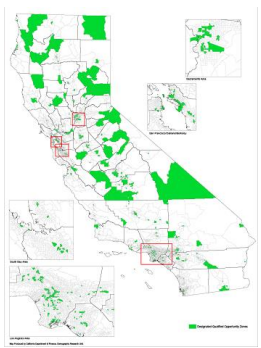
If you are a real estate investor or simply looking to invest prior investment gains in real estate, consider purchasing property in an “Opportunity Zone.†In the recently passed Tax Cuts and Jobs Act, new incentives are presented for investments made in designated low-income areas across the United States. Some of the impacted areas are here in the Central Valley in the Stanislaus and San Joaquin counties.
An Opportunity Zone is located in an economically distressed or low-income community. Each state designated its qualified areas in hopes of stimulating economic growth and making it appealing for investors to consider investing in these distressed locations.
To take advantage of this opportunity, an “Opportunity Fund†must be set up as either a partnership or corporation for investing in eligible property that is in an Opportunity Zone. The investors will need to use prior investment gains in order to fund the Opportunity Fund.
The new tax law outlines the two major incentives regarding the Opportunity Zones:
- Temporary deferral of inclusion in gross income for capital gains reinvested in a qualified Opportunity Fund, and
- The permanent exclusion of capital gains from the sale or exchange of an investment held for at least 10 years in a qualified Opportunity Fund.
Important things to keep in mind regarding Opportunity Funds are:
- Qualified Opportunity Zone business property is tangible property used in the business that is located in the opportunity zone purchased by the qualified Opportunity Zone Fund after 12/31/17.
- The Opportunity Fund must hold at least 90% of its assets in qualified Opportunity Zone property. If the fund fails to do so, you will be subject to penalties.
- If the tangible property ceases to be qualified Opportunity Zone business property, then it will be treated as qualified Opportunity Zone business property for the lesser of
- Five years after the date it ceased to be qualified or
- The date on which it is no longer held by the qualified Opportunity Zone business.
A taxpayer can sell any property, capital asset or other, and any amount of the sale that is invested by the taxpayer in a qualified Opportunity Fund will be excluded from gross income in the year of the exchange (during the 180-day period that begins on the date of such sale or exchange). The best part of this is that there is no dollar limit on the amount of gain that can be deferred under the temporary deferral election.
In conclusion, a few things you should keep in mind:
- This gain deferral expires December 31, 2026
- Gains will be picked up as income at the earlier of the date the investment is sold or 12/31/2026
- Therefore, on 12/31/2026, 85% of the original deferred gain will be recognized. However, you will recognize the lesser of the original gain or the FMV at that date; the appreciation of the investment will not be recognized until the asset is sold, and if the appreciated asset is held 10 years, it will have a step-up to the FMV and be tax-free.
If this is something of interest to you and you would like to further discuss it with me, please feel free to call and set up an appointment.
Very truly yours,
David McCoy
Certified Public Accountant